


Building a Sustainable Future Together
ESG Commitment & Policies
United Solar is committed to promoting technological innovation and expanding its global market influence to meet the growing demand for clean energy and protect our home planet. Guided by the core values of "Innovation, Quality, Health, Safety, and Sustainable Development", we focus on achieving the shared vision of a cleaner and more sustainable energy future while ensuring a happy and safe working environment for all employees, suppliers, contractors and subcontractors, creating substantial value for shareholders, and achieving win-win cooperation with partners.
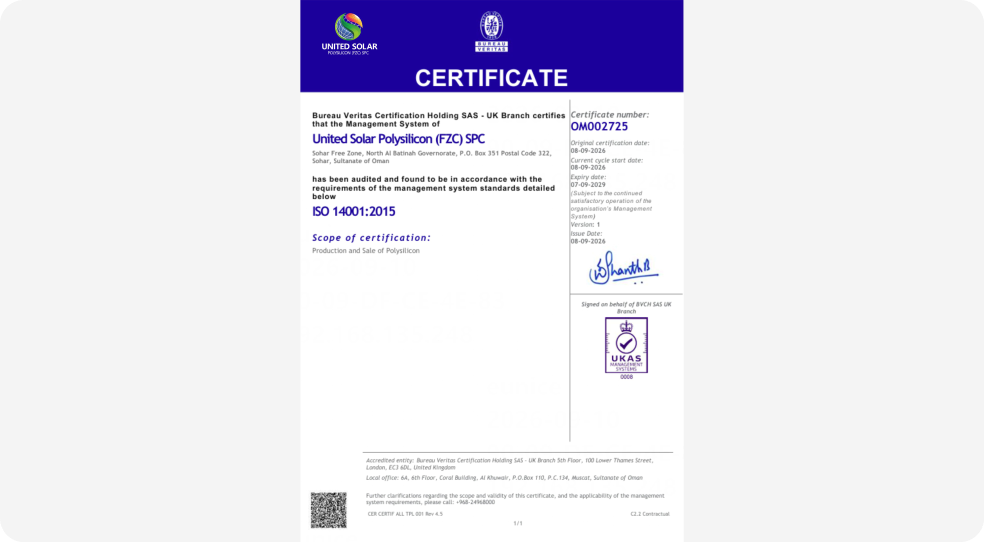
We are dedicated to complying with all applicable regulations in Oman, as well as adhering to Good International Industry Practices (IFC Performance Standards) and other relevant international standards.
The Chairman is responsible for executing this policy, overseeing conformance, and ensuring accountability at all organizational levels—with clear communication of roles and responsibilities to employees, contractors, subcontractors, and suppliers through formal training and documentation.

Environmental Policy
United Solar emphasizes environmental sustainability through strengthened pollution prevention, promotion of eco-friendly practices, energy efficiency optimization, and minimization of greenhouse gas (GHG) emissions across all operations. Established a formal environment management system to systematically identify, assess and manage environment risks and impacts across all operations including but not limited to:
· Stringent Air, water and soil pollution control.
· Enhanced resource efficiency.
· Reducing waste and promoting circular economy.
· Biodiversity conservation.
· Sustainable conservation of living natural resources.
· Enhanced resource efficiency.
· Reducing waste and promoting circular economy.
· Biodiversity conservation.
· Sustainable conservation of living natural resources.

Safety and Occupational Health Policy
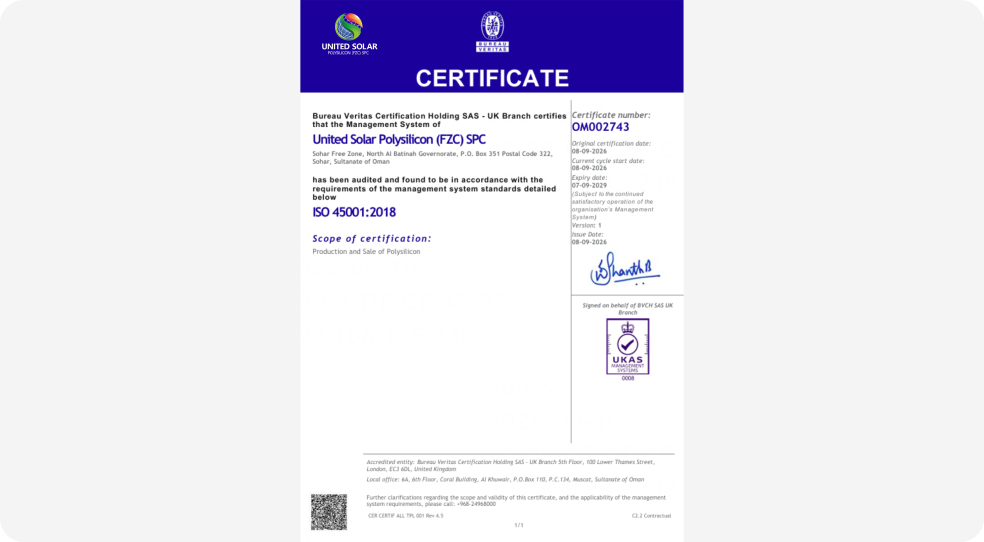
United Solar always prioritizes occupational health and safety by establishing and implementing robust regulations to prevent all types of safety incidents to the extent possible and avoid work related injuries and illness, while safeguarding the safety of employees, contractors, and suppliers.
· Compliance with Omani and International regulations.
· Company-wide Safety/Production responsibility system.
· Integrating PDCA cycle.
· Prioritize enhancing employee skills through OHS training.
· Establish and implement emergency preparedness and response plan to provide rapid response for emergencies.
· Promoting employees to report OHS observations and Incidents.

Social Policy
United Solar always prioritizes human rights and equality by promoting diversity, equity, and inclusion across all operations to create a welcoming workplace for everyone. We strictly protect employee dignity, ensure fair labor standards, and actively invest in our local communities to support their long-term growth and well-being.
· Employee rights protection.
· Anti-discrimination, equality of opportunities.
· Strict rules of Gender-Based Violence and Harassment.
· No child or forced labor.
· Migrant work protection.
· Stakeholder Engagement.
· Supply chain social sustainability.
· Local content and community development.
· Anti-discrimination, equality of opportunities.
· Strict rules of Gender-Based Violence and Harassment.
· No child or forced labor.
· Migrant work protection.
· Stakeholder Engagement.
· Supply chain social sustainability.
· Local content and community development.
Environment and Social Governance Structure
USP has established a structured ESG governance framework with clear roles and responsibilities across the Board of Directors, ESG Committee and operational management teams to ensure effective oversight and implementation of ESG-related matters. ESG responsibilities are embedded throughout the organization, enabling accountability at all levels of the business. The company maintains ongoing engagement with employees, contractors, suppliers, local communities and other stakeholders through communication and grievance mechanisms. To support effective ESG management, United Solar has implemented procedures and management systems covering environmental protection, occupational health and safety, labor practices, contractor management, risk assessment, incident reporting, performance monitoring, and corrective actions.


ESG Committee
USP has also developed the ESG Committee and it is led by CEO of the enterprise. This ESG Committee is of high strategic importance, as it carries the critical mission of implementing the company’s ESG fundamental framework and system. All members need to fully recognize its significance, take initiative, actively participate, and collaborate effectively to ensure that the committee’s various tasks are carried out efficiently and in an orderly manner, thereby laying a solid foundation for the company’s sustainable development and long-term value enhancement.
The ESG Committee provides guidance on ESG priorities, reviews performance, oversees ESG-related risks and opportunities, and supports the integration of ESG considerations into business operations and decision-making processes.
The ESG Committee provides guidance on ESG priorities, reviews performance, oversees ESG-related risks and opportunities, and supports the integration of ESG considerations into business operations and decision-making processes.

ESG and Sustainability Department
To support the implementation of the Company’s ESG commitments, United Solar has established a dedicated ESG and Sustainability Department. The department is led by the Head of ESG Affairs and managed by the ESG and Sustainability Manager.
The ESG and Sustainability Department is responsible for coordinating the implementation of the Environmental and Social Management System (ESMS), monitoring ESG performance, identifying improvement opportunities, and reporting progress to the ESG Committee. The department also supports the development of ESG objectives, action plans, and reporting initiatives across the organization.
The ESG and Sustainability Department is responsible for coordinating the implementation of the Environmental and Social Management System (ESMS), monitoring ESG performance, identifying improvement opportunities, and reporting progress to the ESG Committee. The department also supports the development of ESG objectives, action plans, and reporting initiatives across the organization.

Department ESG Specialists
To strengthen ESG implementation across all business functions, ESG and Sustainability department has assigned and trained employees from each department and nominated them as a Department ESG Specialist. The department ESG specialists are responsible for day-to-day ESG activities in their respective departments and report to ESG and Sustainability department.
Environmental and Social Management System (ESMS)
USP has established an Environmental & Social Management System (ESMS) aligned with applicable IFC Performance Standards, lender requirements, and relevant Omani and international guidelines. The ESMS applies a risk-based management approach to identify, assess, mitigate and monitor environmental and social risks throughout project activities, contractor operations and supply chains. The system focuses on pollution prevention, resource efficiency, occupational health & safety, worker rights protection, community health and safety, responsible sourcing and stakeholder engagement. USP is committed to regulatory compliance, proactive risk prevention, transparent grievance management, and continuous improvement through monitoring, training and periodic review.

ESMS Principles
· Risk based management.
· Accountability and governance.
· Proactive prevention.
· Integration and coordination.
· Compliance and alignment.
· Stakeholder’s centricity.
· Continuous improvement.
· Accountability and governance.
· Proactive prevention.
· Integration and coordination.
· Compliance and alignment.
· Stakeholder’s centricity.
· Continuous improvement.
ESMS Components
· Occupational Health, Safety and Emergency Preparedness.
· Environment Management and Pollution Prevention.
· Resource efficiency and Climate management.
· Labor, Human Rights and Community Relations.
· Stakeholder Engagement and Grievance Management.
· Contractor and Supply Chain Management.
· Risk Management, Monitoring and Continuous Improvement.
· Environment Management and Pollution Prevention.
· Resource efficiency and Climate management.
· Labor, Human Rights and Community Relations.
· Stakeholder Engagement and Grievance Management.
· Contractor and Supply Chain Management.
· Risk Management, Monitoring and Continuous Improvement.
ESG Objectives
USP is committed to embedding ESG principles into every stage of our business development. Our ESG objectives guide decision-making, strengthen operational resilience and support long-term value creation for our stakeholders.

Manage Environment & Social Risks

Ensure Compliance & Responsible Operations

Protect People & Nature

Engage Stakeholders

Drive Continuous Improvement
ESG Management

Environment
What have we done?
- Achieved zero water discharge.
- Implemented vent gas recovery initiatives.
- Ensuring waste disposal in compliance with regulatory requirements.
What we plan to do? Our target,
- Establish baseline greenhouse gas emissions and identify reduction opportunities.
- Implement monitoring systems to identify opportunities for improved energy and water efficiency.
- Explore renewable energy opportunities.
- Minimize waste generation and adopting circular economy practices.
- Promote sustainable sourcing practices.
Social
What have we done?
- Training and upskilling programs.
- Occupational health and safety of Employees and stakeholders.
- Fund and support employee wellness and recreational activities.
- Contribute to social development initiatives.
- Supporting next generation talent through university internships and job opportunities of locals.
- Support local tradition, celebrate local festivals, provide gifts and bonuses to employees.
- Implemented international labor standards across the value chain (fare wages, equal opportunities, prohibition on gender-based violence, harassment and discrimination).
What we plan to do? Our target,
- Promote diversity, equity & inclusion.
- Ensure employee well-being and engagement.
- Support local communities.
- Continuous improvement in social performance.
Governance
What have we done?
- Developed ESG Policy and ESMS framework aligned with local and international regulations.
- Implemented whistleblowing and grievance mechanisms.
- Defined clear roles and responsibilities across the organization.
- Adopted anti-corruption and bribery policy.
- Formed ESG Committee.
- Strengthening Data Privacy and confidentiality.
- Implemented supply chain management system.
What we plan to do? Our target,
- Strengthen ethical leadership.
- To enhance transparency & accountability.
- Integrate ESG considerations into risk management.
- Continuously improve responsible supply chain practices.

Grievance Mechanism
USP is committed to maintaining open, transparent and respectful engagement with all stakeholders. We have established an accessible grievance mechanism that enables employees, contractors, suppliers, local communities and other stakeholders to raise concern through trusted communication channels. This grievance mechanism covers complaints including but not limited to environment impacts, social impacts, community health, safety and security, discrimination, Gender-Based Violence and Harassment, unfair treatment, breach of public commitments, local laws and policies. USP always ensures that every grievance is managed through a fair, confidential and timely process, supporting stakeholder trust and continual improvement.
Our Commitments
-
 Accessibility
-
 Transparency
-
 Fairness and Impartiality
-
 Confidentiality
-
 Non-Retaliation
-
 Feedback
How to Raise Concern
Complainants have the option to submit grievance either in their real name or anonymously. USP will respect and protect their information throughout the grievance handling process.
General Grievance
 Grievance Mailbox
PublicGrievance@unitedsolarholding.com
 Grievance Hotline
+968 21154528
USP has established the dedicated grievance channel for Gender-Based Violence and Harassment (GBVH). Anyone who experiences or witnesses GBVH (including but not limited to physical/sexual violence, verbal harassment, psychological abuse, gender discrimination, and GBVH-related retaliation) may report anonymously or in real name via following channels.
 GBVH Grievance Mailbox
USPCEO@unitedsolarholding.com
 GBVH External Hotline
+968 21154520
Grievance Handling and Investigation
USP follows a structured grievance handling and investigation process. Grievances are assessed according to their nature, severity and potential environmental and social risks, and investigated objectively, fairly and confidentially. Findings are documented to determine appropriate corrective or remedial actions, followed by communication of the outcome and formal closure. When the Grievance is received, it undergoes following 7 Steps:
-
 Receive
-
 Acknowledgement
-
 Assess
-
 Investigate
-
 Resolve
-
 Feedback
-
 Close
Grievance Information Protection
USP has implemented technical and administrative measures to protect grievance information from unauthorized access, modification, disclosure, or destruction, ensuring alignment with IFC’s requirements for transparency and accountability.
All grievance-related information (including complainant and witness details, case content, and investigation records) will be treated as strictly confidential and stored in a secure, access-controlled system with restricted access. Access to grievance information is restricted to authorized personnel only, on a strict need-to-know basis related to case handling. Personal information of complainants, survivors, witnesses, and helpers will not be disclosed without their explicit, informed consent, unless required by applicable laws or regulatory authorities. Grievance records shall be retained in compliance with company retention policies and securely disposed of once the retention period expires to prevent information leakage.
All grievance-related information (including complainant and witness details, case content, and investigation records) will be treated as strictly confidential and stored in a secure, access-controlled system with restricted access. Access to grievance information is restricted to authorized personnel only, on a strict need-to-know basis related to case handling. Personal information of complainants, survivors, witnesses, and helpers will not be disclosed without their explicit, informed consent, unless required by applicable laws or regulatory authorities. Grievance records shall be retained in compliance with company retention policies and securely disposed of once the retention period expires to prevent information leakage.
Sustainable Development

Contributions
At full capacity, the plant is expected to enable the production of approximately 40 gigawatts of solar modules annually, enough to power up to 12 million homes. It will also contribute to the avoidance of 40 million tons of greenhouse gas emissions per year. The polysilicon plant aims to strengthen the resilience and diversification of the global solar PV supply chain and expand clean energy access. The polysilicon produced from the plant will also be fully traceable, enhancing transparency, and competitiveness.

Commitments
As USP continues to grow, we are committed to integrating sustainability into every aspect of our business. Guided by our ESG strategy, we will continue strengthening governance, protecting people and the environment, promoting responsible supply chains and creating long-term value for all stakeholders.
· Environmental Stewardship.
· People & Safety.
· Ethics & Governance.
· Responsible Supply Chain.
· Continuous Improvement.
· Community Development.
· Responsible Consumption and Production.
· Environmental Stewardship.
· People & Safety.
· Ethics & Governance.
· Responsible Supply Chain.
· Continuous Improvement.
· Community Development.
· Responsible Consumption and Production.
ESG Annual Report
Annual Report
Year:
2026

2027
2028
 TOP